Eight facets per client - the things that don’t live in the data but make every draft accurate. Built from your reports, your edits, your conversations. Tenant-isolated. Exportable as markdown or JSON, any time.

A glimpse of one client’s memory - you rarely open it. It just feeds Claude.
Memory isn’t a chat history Scout grepped. It’s a structured profile, eight facets per client, each with promoted facts and active observations.
What they sell, who they sell to, how they talk about themselves.
Who signs off, what they care about, what makes them nervous.
What ‘a good week’ looks like for this specific client.
The things on this quarter’s page, in plain language.
The bits only the account manager remembers (e.g. “never mention the Q3 launch”).
How the client wants trade-offs made (e.g. “ROAS over volume, always”).
When this client wants a different tone than the agency default.
The things that show up week after week and shape commentary.
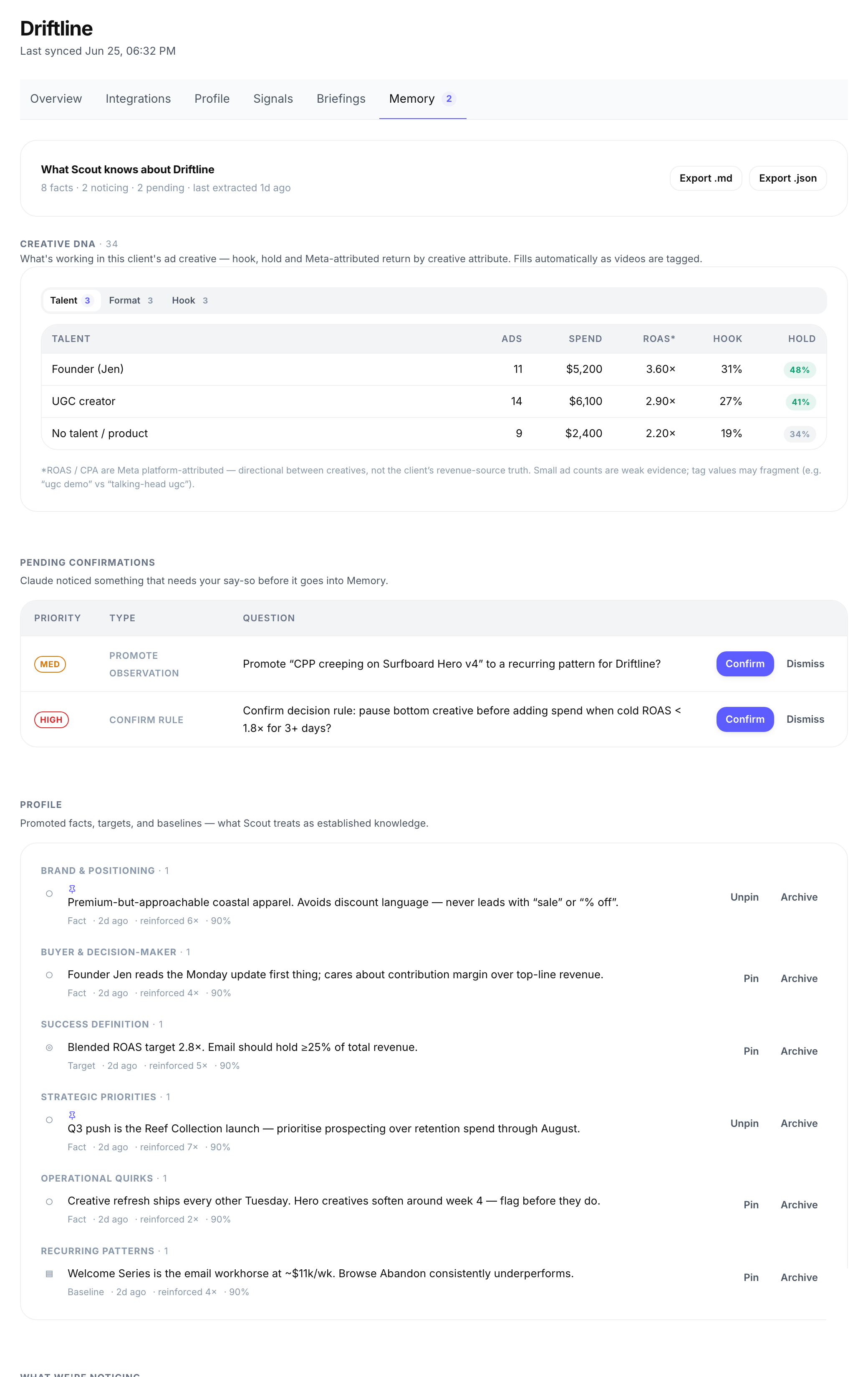
Every time the account manager finalises a report, every mid-week Claude conversation, every edit - Scout extracts observations. They land in a queue. The account manager (or Claude, with your approval) promotes the ones that matter. Promoted observations become permanent facts that feed every future draft and answer.
Dismiss the ones that don’t matter. Archive the ones that aged out. Pin the ones worth surfacing first.
Two account managers promote contradicting observations. Last week’s fact contradicts this week’s. Scout doesn’t silently pick a winner - it surfaces the conflict, shows both observations side by side, and lets you keep one, archive the other, and mark the loser as contradicted.
This is the kind of detail that proves the system is built, not hand-waved. Real agencies generate contradictory observations every week.
Memory is the most valuable thing Scout produces. We keep it portable on purpose.
Markdown for handover to a new tool, a new account manager, a new client doc. JSON for re-importing into whatever AI platform comes next. Today Scout runs on Claude. Tomorrow there’ll be something else. Your structured client knowledge moves with you.
Every Monday draft references the client’s strategic priorities, voice overrides, and active observations. Every mid-week answer pulls from promoted facts before it touches live data. The memory isn’t a vault - it’s the reason Scout’s outputs sound like your agency wrote them.
Scout extracts observations from every finalised report, every mid-week Claude conversation, and every edit you make. You (or Claude, with your approval) promote the ones that matter into permanent facts.
The agency. Memory is structured per client and shared across your whole team, not locked in one person’s Claude account. When an account manager leaves, the client memory stays.
Yes. Promote, dismiss, archive, or pin any observation. When two facts conflict, Scout surfaces both side by side and lets you keep one and mark the other contradicted - it never silently picks a winner.
Completely. Every row carries a workspace_id enforced by Postgres row-level security. Your data is never shared across agencies and is never used to train models.
One click, as markdown or JSON, any time. We keep it portable on purpose - Scout earns durability by being useful, not by holding your data hostage.