Team & Collaboration

Your agency owns the knowledge - not the account manager’s Claude account.

Claude’s memory lives in one person’s account. Projects don’t share structured client knowledge across your team. Scout does. The client memory, the voice profile, the prior reports - all of it sits with the agency, accessible to every account manager, durable through turnover.

Sam
Mira
Theo
Lin
Ade
Agency memory
8 facets · per client
The handover problem

Today: panic. With Scout: continuity.

Before Scout
An account manager leaves.
Old account manager left Friday.
Their Claude account + threads went with them.
New account manager, Monday.
“What does this client even care about?”
Client, Tuesday.
“We covered this last quarter…”
With Scout
The client memory stays.
Old account manager left Friday.
Client memory stays in Scout.
New account manager, Monday.
Opens client memory · sees 12 facets, voice overrides, last 6 reports.
Client, Tuesday.
No-one noticed the handover.
Consistency

Same client, same story, every time.

Scout’s voice profile is agency-level. Whichever account manager is writing this week’s update, the report sounds like the agency. The client hears one consistent voice - not the account manager’s personal style, not whoever happened to be on rotation.

When a client needs a different tone, voice overrides handle it at the client level. The agency default stays the agency default.

S
Sam P.
Solid week - ROAS held at 3.4× on $4.2k spend.
M
Mira K.
Solid week - ROAS held at 3.4× on $4.2k spend.
SAME CLIENT · SAME VOICE
Roles & access

Admins and members, one shared workspace.

Everyone on the team sees every client, every integration, and can draft, edit, and send via Claude. Admins additionally run the team - invite teammates, set roles, remove access. One workspace, not twenty configs spread across three laptops.

Invite a teammate by email and they’re in - same clients, same memory, same voice. No per-account-manager MCP setup, no re-auth.
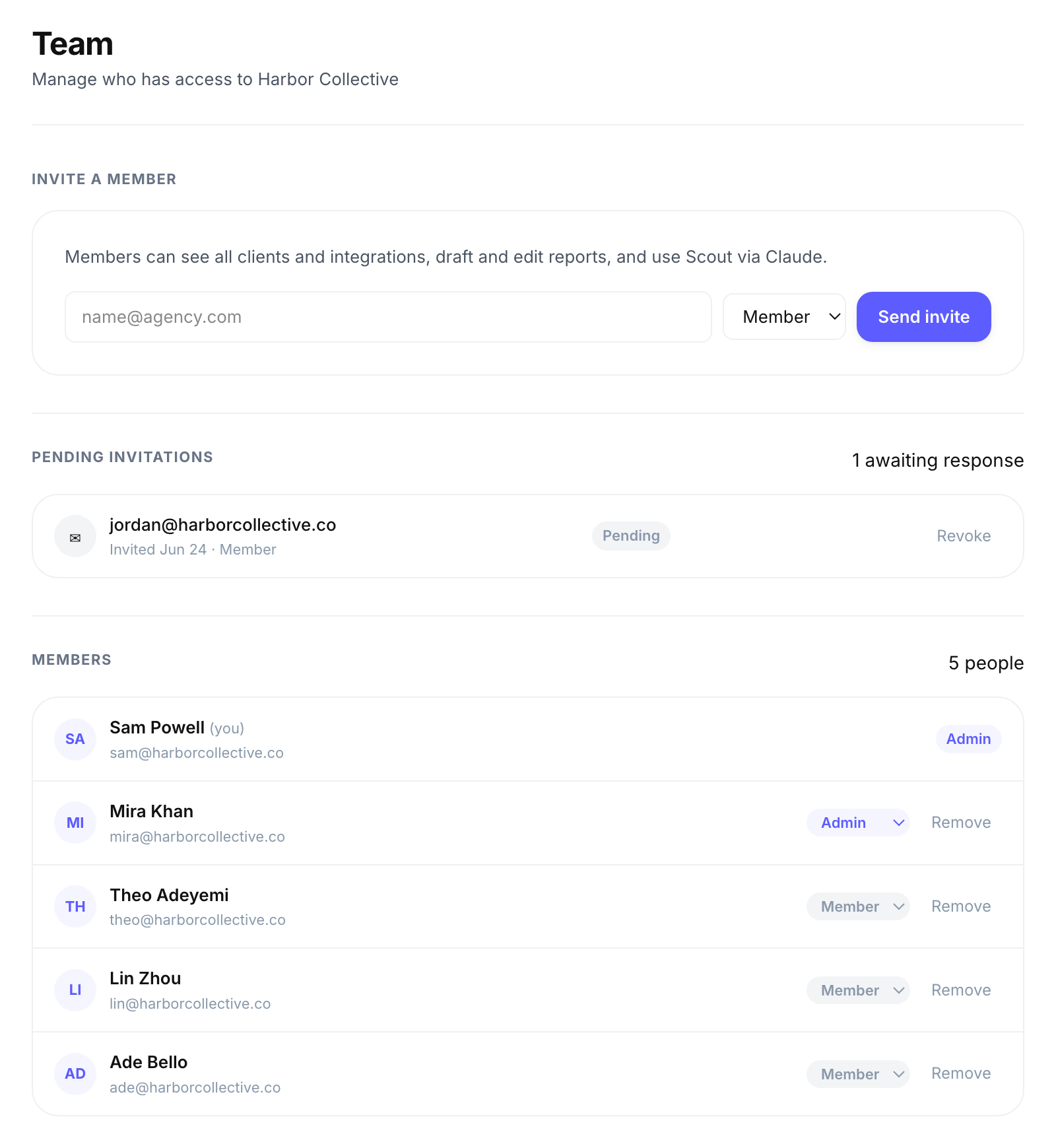
The Scout Team settings - invite a member, pending invitations, and the member list with Admin/Member roles.
Cost vs alternative

What Scout costs vs what it replaces.

A five-client account manager can lose the better part of a Monday morning to reporting. At account-manager-level salary, that’s real money - recurring, every week. Scout’s flat $149/month covers your whole book for less than a single Monday morning of account-manager time.

At fifteen clients, the math changes from ‘worth it’ to ‘obvious.’ At fifty, the alternative is hiring.

The honest comparison

Why a Claude Team subscription isn’t the same thing.

Claude Team is brilliant for individuals collaborating in shared Projects. For an agency running many clients across many account managers, it stops short in four specific ways:

Memory lives in one account manager’s account, not the agency’s. Switch people, lose context.
Projects don’t enforce structured per-client knowledge. There’s no schema, no extraction loop, no resolution flow.
No multi-account stitching for client platforms. Shopify, Meta, Klaviyo - everyone wires them up themselves, per project.
No publish-and-send pipeline. The draft never leaves the chat as a polished, audit-trailed deliverable.

Scout sits on top of Claude. Use Claude Team for what it’s great at; use Scout for the agency-scale work it isn’t built for.

FAQ

Common questions about teams.

What roles does Scout support?

Admins and members. Everyone sees every client and can draft, edit and send via Claude; admins additionally manage the team - invite teammates, set roles, and remove access.

Do you charge per seat?

No. Pro includes your whole team at one flat price. Invite every account manager at no extra cost - same shared workspace, same client memory, same voice.

What happens when an account manager leaves?

The client memory, voice profile and prior reports stay with the agency. The next account manager opens the client and sees everything - no scramble, no lost context.

How is this different from Claude Team?

Claude Team is great for individuals in shared Projects, but memory still lives in one account, there’s no structured per-client knowledge, no multi-account stitching, and no publish-and-send pipeline. Scout adds exactly those agency-scale pieces on top of Claude.

See how Scout fits your agency’s team.