Every platform has an MCP now - but wiring them up for a whole client book is messier than it looks. Some span accounts through one login (Meta’s Business Suite MCP, Google Analytics); others are one account at a time (Klaviyo and Shopify - disconnect, reconnect, repeat). And none of them do the layer above the connection: memory, voice, tenancy, delivery. That’s the part Scout does.
The platforms are all over the map on this. Meta’s official MCP authenticates through Business Suite, so one connection reaches every ad account you manage - switch by name, no re-auth. Google Analytics is similar: it reads any property your Google account can see. Klaviyo and Shopify are the opposite - one account or store per connection, so adding a client means disconnect, reconnect. Either way, wiring the connection is the easy part; everything above it is what makes an agency run.
What they don’t do - and aren’t trying to do - is the layer above the connection. An agency running ten clients across five platforms needs more than five well-wired MCPs. It needs memory that survives between conversations, voice that holds across account managers, output that goes to the client, and a single shared workspace instead of twenty config files spread across three laptops.
Every account manager installs and re-auths every MCP themselves. No memory between sessions. No shared voice. No published reports. You still write Monday yourself.
Connect each client account once, agency-wide. Structured memory per client. Voice that learns. Reports drafted, published, and sent. One source of truth for every account manager.
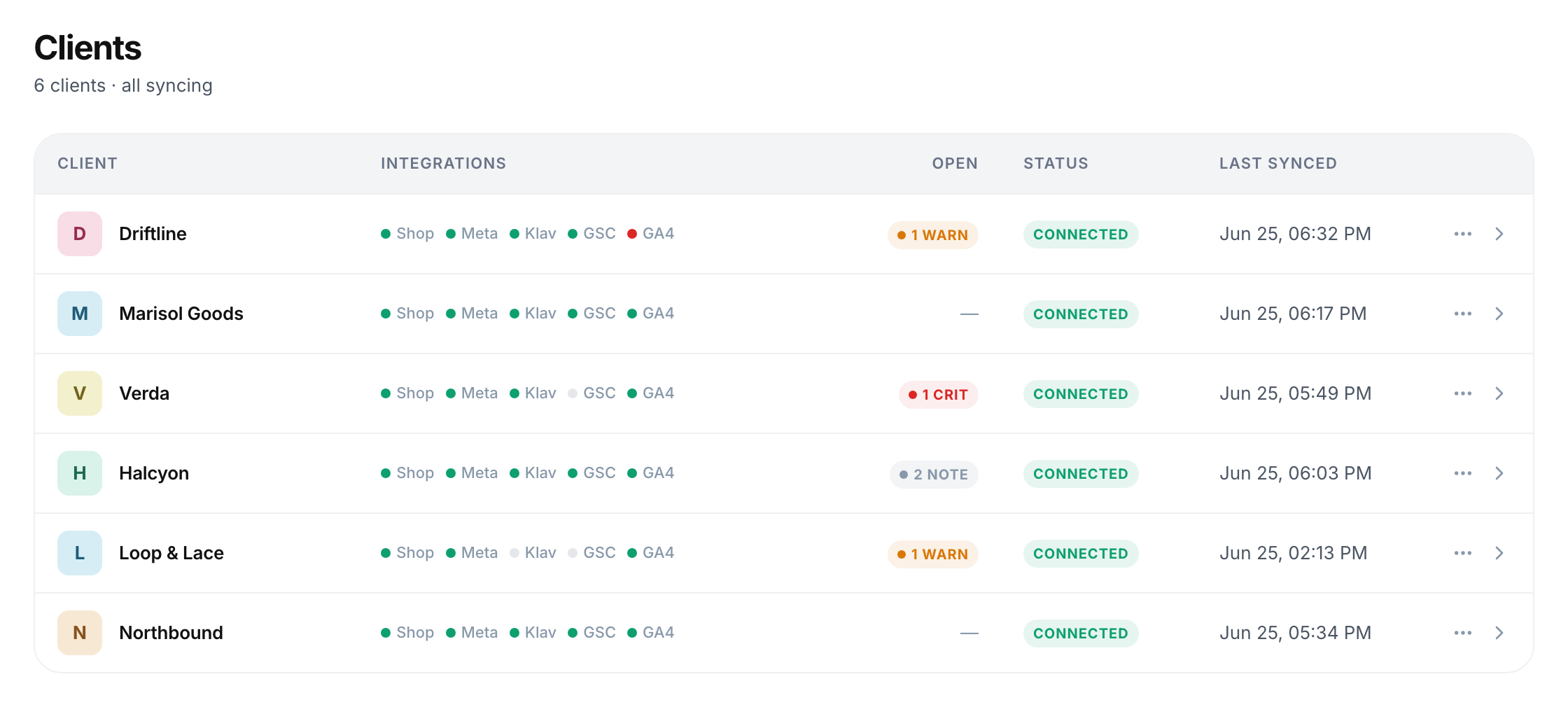
Scout connects to each client’s account once, via OAuth, scoped read-only. The agency holds the connection; the account manager picks the client; Claude operates on that client’s data for that conversation. Switch client mid-chat and the context follows.
Every row in every table carries a workspace_id and is enforced by Postgres row-level security. Client A’s data never touches Client B’s context. Agencies never touch each other’s anything.
Revenue, orders, AOV, SKU performance, repeat rate. Read directly from the Admin API.
Spend, ROAS, attributed conversions, creative-level performance. Plus base64 creative thumbnails for inline reference.
Flow and campaign performance, revenue per recipient, send-time, list health.
Clicks, impressions, average position, top queries. The honest organic story.
Sessions, sources, landing pages. Cross-checked against Shopify for revenue truth.
Not a feature we haven’t built - a deliberate product opinion. Reporting and write actions are different jobs. Scout does one of them. Your campaigns are touched by humans, not by a layer of automation you can’t fully see.
As many as you run. Pro is one flat price for unlimited clients - connect 5 or 50, the price doesn’t change.
Yes. Every integration is OAuth per client account, scoped read-only. Scout never writes to your clients’ Shopify or ad platforms - by deliberate product design.
No. You connect each client once, agency-wide. Every account manager works from the same connections - no per-person install, no re-auth on each machine.
The context follows. Scout swaps to that client’s data, memory and voice for the conversation, so you can ask about three different clients in three minutes in one thread.
Shopify, Meta Ads, Klaviyo, Google Search Console and GA4 - the five ecommerce/performance stacks, done deeply, rather than a shallow list of fifty.