Scout drafts them in Claude - in your agency’s voice, with real numbers from Shopify, Klaviyo, Meta, Search Console and GA4. Every Monday, the update is waiting, ready to edit and send.
Open Claude. Ask. Scout assembles the week from every client account, loads the client’s memory, applies your agency’s voice, and hands back a draft you can send. The whole thing takes about as long as making coffee.
On it - pulling Driftline’s week together from every connected account.
Here’s Monday’s draft - in your voice, ready to edit:
Scout isn’t a dashboard or a template. It’s the agency layer between Claude and your clients’ accounts - the thing that turns Claude from a brilliant generalist into something that actually knows your book.
Drafts ready before you open Slack. In your agency’s voice. With the right numbers.
Eight structured facets per client. Owned by the agency, not the account manager. Exportable any time.
Ask anything about any client, any day of the week. Live data, real answers.
Klaviyo, Meta, Shopify all have MCPs now - but they’re uneven (Meta and Google Analytics span accounts through one login; Klaviyo and Shopify are one at a time). Scout is the part that sits on top: structured memory per client, agency voice, published reports, one shared workspace for every account manager.
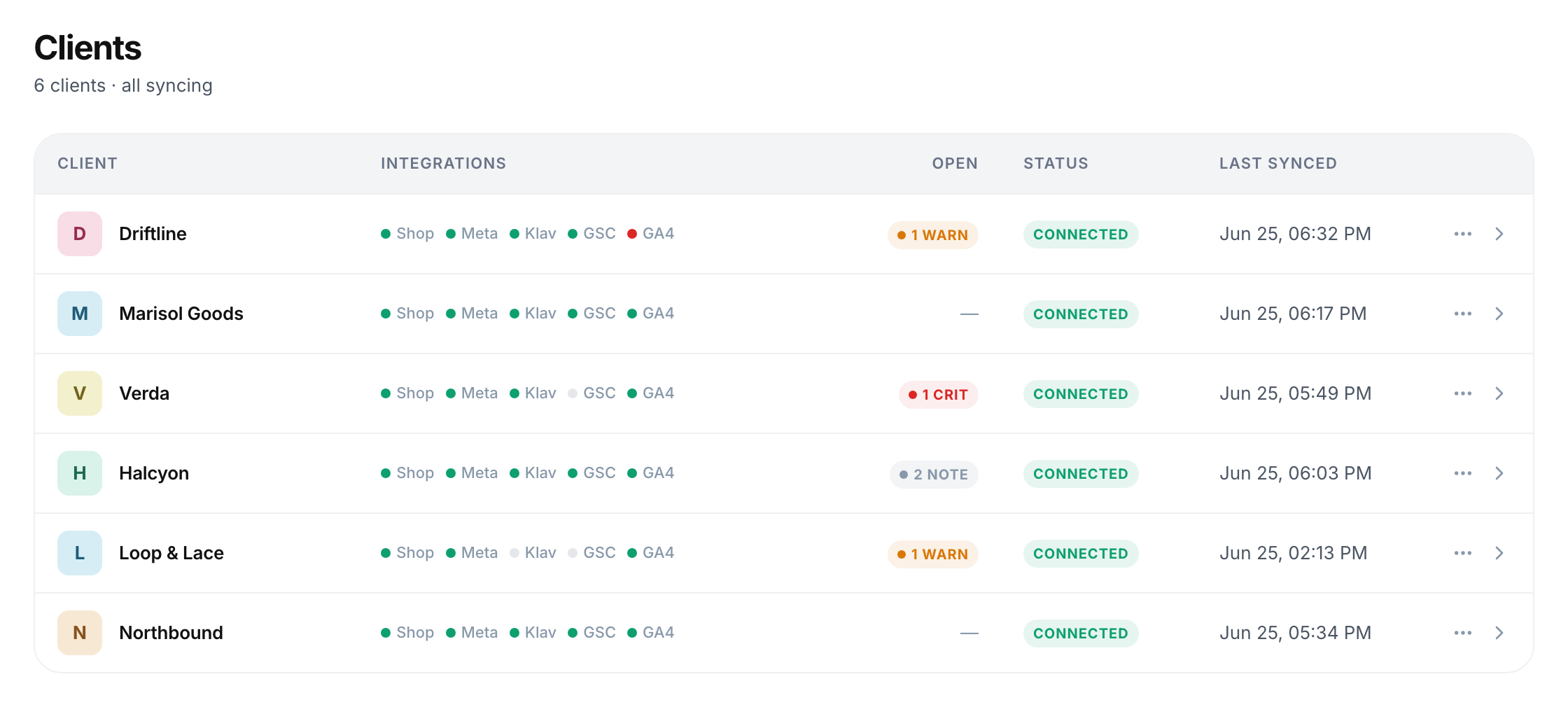
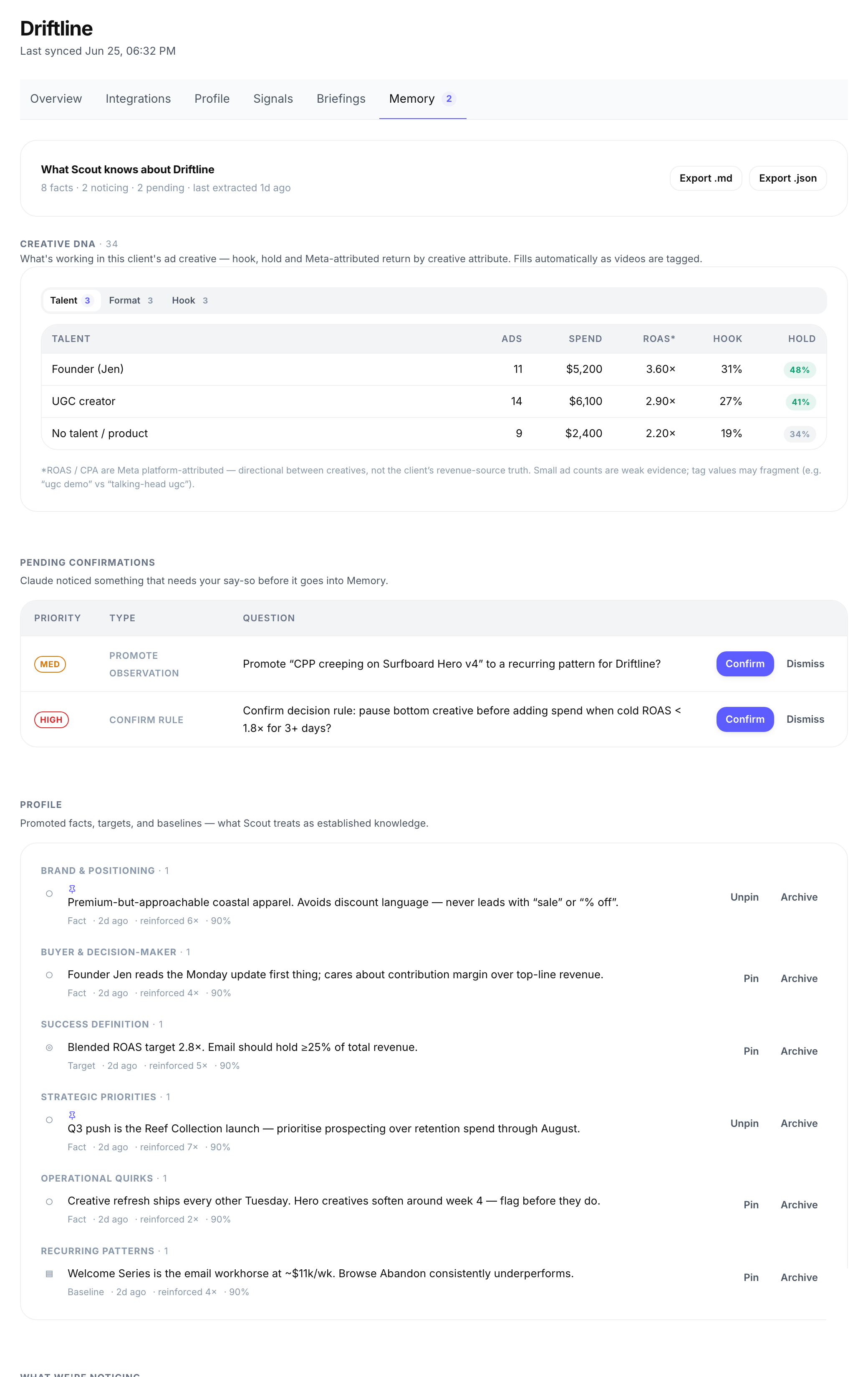
Claude’s memory lives in one account manager’s account. Scout’s memory is structured into eight facets per client, owned by the agency, accessible to every account manager, exportable any time. Account managers change. The client memory stays.

A glimpse of one client’s memory - you rarely open it. It just feeds Claude.
Mid-conversation, Claude spots something worth remembering and writes it up.
It waits in Scout until you say yes. The only moment you lift a finger.
From then on it’s in the client’s memory - in every draft and every answer.
No data entry, no upkeep. Scout builds the memory; you just nod it through.
No new app to learn, no dashboard to refresh. Your account managers ask Claude the way they already do - and because Scout has loaded the client’s memory, decision rules, voice, and this week’s live numbers, the answer actually knows the account.
Solid week - but I’d hold on cold. Three things:
So: pause Surfboard Hero v4, hold cold budget, and let the Welcome flow keep carrying email ($8.40/recipient). Want me to draft the client note?
Eight facets, decision rules, and voice v7 - the agency’s, not one account manager’s Claude account.
This week’s Meta and Klaviyo numbers, fetched on the spot - no dashboard, no exports.
Short, efficiency-first, and it offered the next step - exactly how your team writes.
No prompts to memorise, no dashboards to open. Once a client is connected, your account managers ask in plain English - and Scout makes sure the answer knows the account.
Most tools you’re weighing solve one piece of one client’s problem. Scout is the layer that turns the whole stack into something an agency can actually run on.
Between the moments anyone’s asking, five jobs are running. Memory builds, voice sharpens, data stays fresh, problems get flagged - all without an account manager lifting a finger.
Every client. Live data from Shopify, Meta, Klaviyo, GSC, GA4 - stitched, voiced, drafted. Ready before you open Claude.
Headline metrics, what moved, anything flagged overnight. Per-client cadence - daily, weekly, or off.
Every conversation, every edit, every promoted fact updates the structured 8-facet profile. The moat builds itself.
Stale syncs, broken OAuth, missing data, capability gaps - Scout flags it before the account manager notices it’s broken.
Meta unsettled. ROAS below target. Flow paused. Quiet by default - only fires when worth your attention.
Currently in private beta with our first agencies. One flat price - the same product whether you run 5 clients or 50.
Scout has delivered on its ROI, and then some. We can't operate our agency at the speed, efficiency and insight we need without it.
A lifetime beta discount on Pro. Direct Slack with the team. Onboarding in under an hour.